World War I by Allan Burnett
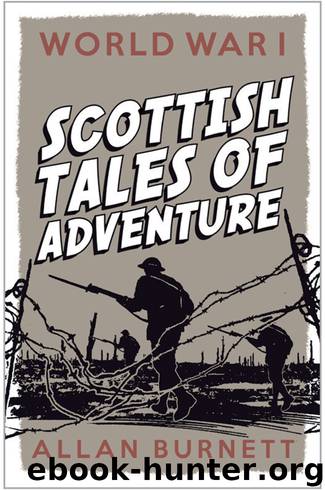
Author:Allan Burnett
Language: eng
Format: epub, azw3
Publisher: Birlinn
WAR REPORT
Personnel: William Raynor Wilcock was a Private in the Gordon Highlanders. During the war he kept a personal memoir in which he charted his experiences, including his arrival in France in the summer of 1915 and his part in the Battle of Loos. He was invalided out of the army in April 1917.
Wilcock came from Leigh, an industrial town in Lancashire, England. It was not unusual for men living outside Scotland to enlist in a Scottish regiment, especially if they had been born in Scotland or had a Scottish parent, or some other connection to the part of Scotland where the regiment traditionally recruited.
Wilcock’s Gordon Highlanders were among several Scottish regiments to take part in the Battle of Loos. The others included the Black Watch, the Cameron Highlanders, the Highland Light Infantry, the King’s Own Scottish Borderers, the Royal Scots Fusiliers, the Scots Guards, the Seaforth Highlanders, the Scottish Rifles, and the Argyll and Sutherland Highlanders.
Event Log: The Battle of Loos was fought between 25 September and 18 October 1915. The battle was named after a small mining village in the north of France called Loos – pronounced ‘Loss’. This battle was the first time the British used poisonous chlorine gas.
Loos is in an area called Artois, about 20 miles south of the French border with Belgium. The battle was part of a bigger plan of attack by the British and French against the Germans. The plan was called ‘the Artois offensive’.
At the start of the battle the Germans occupied Loos and the land to the east of it. The British were stationed to the west. So the British objective was to advance east, capture Loos and break through the German lines beyond.
The British had bombarded the Germans with heavy artillery for four days before the actual battle began. Around 250,000 British artillery shells were fired during that time.
Wilcock was part of an advance by Scottish regiments through Loos, which was successfully taken from the Germans, and then on to a bit of higher ground to the east known as Hill 70. The Germans bombarded them while they advanced to Loos and then counter-attacked fiercely when they got to Hill 70. Wilcock’s company was eventually relieved by reserves.
The British released 140 tons of gas from canisters on the battlefield. It was supposed to blow towards the Germans but the wind changed strength and direction, and as a result much of it ended up swirling around the British troops. Wilcock was among the many Tommies to be gassed by his own side.
The British were unable to hold the ground gained at Hill 70, so on 28 September they retreated. They tried the attack again in October, but that was unsuccessful too.
In total around 60,000 British soldiers were either killed, wounded or missing as a result of the battle, and a very high proportion of them were Scots. The German losses were far fewer.
Inventory: The Lee Enfield rifle was the British soldier’s main weapon during the First World War. It was
Download
This site does not store any files on its server. We only index and link to content provided by other sites. Please contact the content providers to delete copyright contents if any and email us, we'll remove relevant links or contents immediately.
Waking Up in Heaven: A True Story of Brokenness, Heaven, and Life Again by McVea Crystal & Tresniowski Alex(37808)
Empire of the Sikhs by Patwant Singh(23084)
We're Going to Need More Wine by Gabrielle Union(19045)
Hans Sturm: A Soldier's Odyssey on the Eastern Front by Gordon Williamson(18590)
Leonardo da Vinci by Walter Isaacson(13336)
The Radium Girls by Kate Moore(12026)
Tools of Titans by Timothy Ferriss(8393)
Educated by Tara Westover(8053)
How to Be a Bawse: A Guide to Conquering Life by Lilly Singh(7486)
Permanent Record by Edward Snowden(5846)
The Last Black Unicorn by Tiffany Haddish(5635)
The Rise and Fall of Senator Joe McCarthy by James Cross Giblin(5280)
Promise Me, Dad by Joe Biden(5153)
The Wind in My Hair by Masih Alinejad(5095)
A Higher Loyalty: Truth, Lies, and Leadership by James Comey(4959)
The Crown by Robert Lacey(4814)
The Iron Duke by The Iron Duke(4354)
Joan of Arc by Mary Gordon(4109)
Stalin by Stephen Kotkin(3965)
